

With, Not For
Why the people we keep missing don't need our services — they need our lives
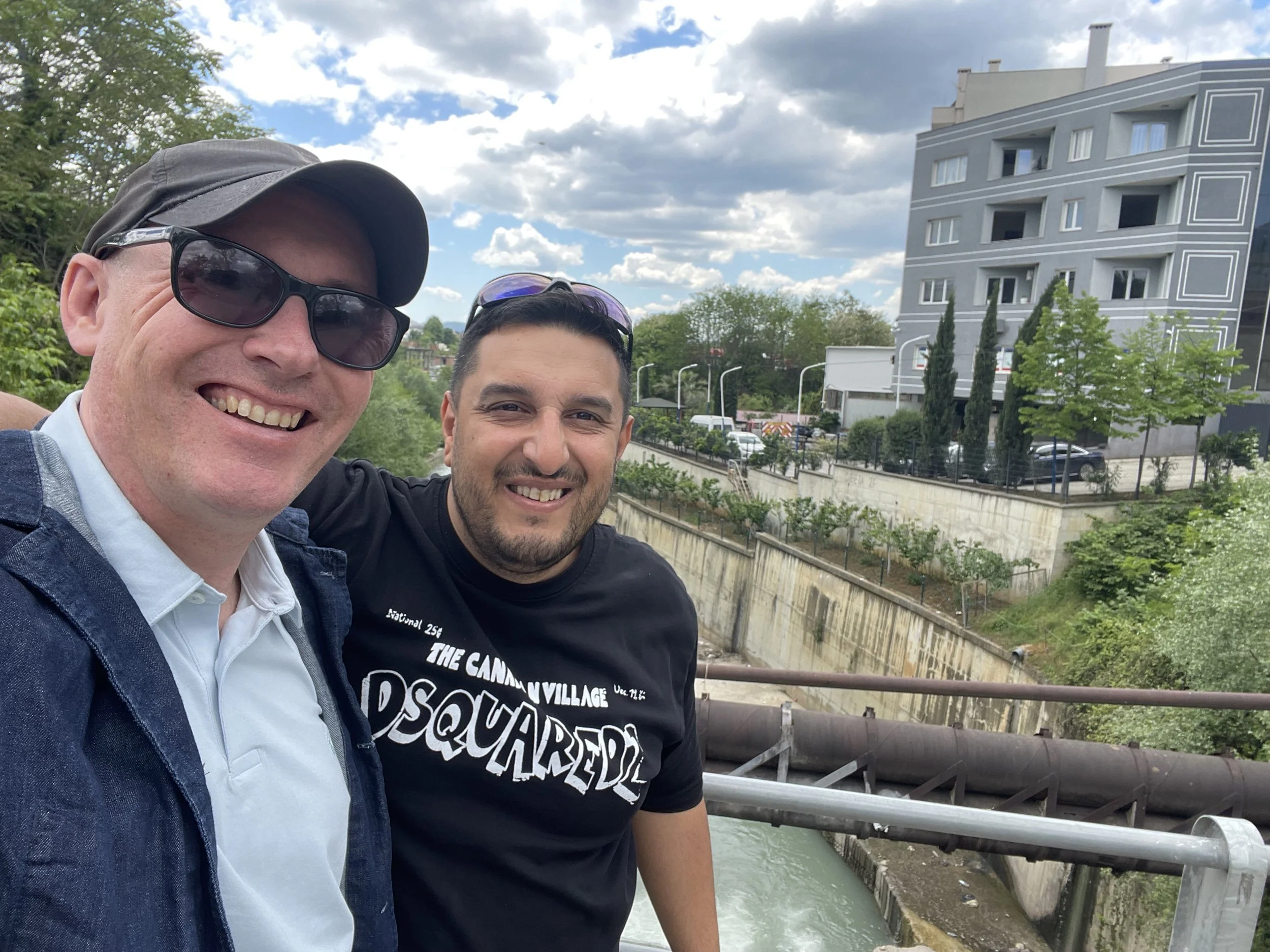
Ten years beside a Tirana bridge taught us something the British church has forgotten. This article is written with gratitude, and with a challenge.
Let me tell you about a door in Tirana.
It belongs to a community centre on Rruga Faik Kulla, run by Tek Ura — the mission my wife Annie and I founded in Albania ten years ago. The name means “at the bridge.” And the most important thing about that door is boringly simple: it is open, and stays open, at least five days a week.
On Monday it might be physiotherapy for children with disabilities. Tuesday, homework club and English classes. Wednesday, the drop-in — no appointment, no referral, no forms to fill in before you qualify for kindness; over a thousand attendances a year come through that open door. Thursday, the careers group, the carers' group, the older persons' social. And on Sunday, worship happens in the same rooms, among the same people, led by the same faces. A mum whose son comes for sensory therapy might be in the building four times before Sunday ever arrives. By the time she stands in worship — and many do, eventually — she isn't visiting a church. She's home.
Now think about the average British church building. And let me be fair, because we are not always generous here: many of our buildings are busy midweek — toddler group Tuesday, food bank Friday, a warm space in winter, the hall let most evenings — and many ministers give far more hours than anyone ever sees. But busy with rotas and lettings is not the same as open with a shared life. The question is not whether the hall is in use. It is whether anyone in the food bank queue would call the people there theirs. And for too many of us the honest picture still ends the same way: sanctuary locked six days a week, worship for two hours on the seventh, minister available by appointment.
We usually assume that mission wisdom travels from Britain to places like Albania. We sent the missionaries, after all. But after a decade beside the bridge, in one of the poorest countries in Europe, I have become convinced that on this question — how the church should place itself among people in need — the wisdom now travels the other way.
And here is something Albanians would want you to know before we go further: they would smile at a Briton marvelling that a door stands open. Albania is the land of besa — the ancient code by which hospitality is sacred, a promise is kept, and the guest is under the household's protection — and the people who gave the world Mother Teresa, the most recognised practitioner of presence among the poorest the modern world has known. When our neighbours opened their homes to us long before we had anything to offer them, we were not importing a relational culture into Albania. We were meeting one. Tek Ura's open door is not a Western innovation planted in Albanian soil; it is Albanian soil, watered.
The distance we learned
Start with honesty about how we got here, because nobody chose it on purpose.
Over recent decades, British churches have rightly become more professional. Safer recruitment. Safeguarding training. Ministerial codes of conduct. Supervision. All of this is good, and nothing in this article argues against a word of it. But along with those necessary disciplines, we quietly absorbed something else from professional culture: its relational architecture. The case. The client. The referral. The office hour. The firm line between the practitioner's life and the lives of those they serve. Social work and healthcare teach that architecture for serious reasons — and I can say so with some authority, because I trained and worked as a social worker, and Annie is a physiotherapist who still practises in the NHS. We were formed in the two professions where “keep your professional distance” is drilled deepest.
Carried into ministry, though, those habits produced something Scripture would struggle to recognise: the minister as service provider. Help delivered across a table, or through a hatch. Home life and ministry kept firmly apart. A minister who eats weekly in the homes of struggling families, whose children play with theirs, who is known at the school gate before being known in the pulpit, risks being described — in the borrowed language of the professional register — as “over-involved.” Somewhere along the way, “don't get too close” started to sound like wisdom.
Here is the problem. For people whose lives are comfortable, a church that keeps a friendly distance is fine — they have other places to belong. But for the people Jesus kept eating with — the isolated, the struggling, the written-off — distance is precisely the wound. Britain is not short of services; it is full of them. What the most excluded people lack is not provision but a people to belong to. And a church that offers help-at-a-distance, however kindly, joins a long queue of professionals who assess them, refer them, and go home.
A role is closed at five o'clock. A life is something you can belong to.
What the Word shows
Jesus spent around thirty years in Nazareth simply living among people — working, eating, belonging — and about three years in public ministry. The theologian Samuel Wells has built a whole account of mission on that arithmetic: God's own preferred way of loving people is being with them, from which working for them flows. We have built a church that reverses His ratio.
Two honest cautions keep this biblical rather than fashionable. First, the cross itself is the supreme act of working for — Christ doing for us what we could never do for ourselves — so nobody should turn “being with” into the whole gospel. We take the point, and keep the atonement. Second, Scripture's own counter-texts deserve a straight answer. In Acts 6 the apostles hand the daily food distribution to others so they can give themselves to prayer and the Word — but look closely: the passage multiplies table-servants rather than closing the table, and the Seven turn out to be Spirit-filled evangelists. Acts 6 differentiates callings; it nowhere licenses distance. And in Mark 1 Jesus withdraws from Capernaum's queue of need to pray in a lonely place. The available Christ is also the withdrawing Christ — which is not an argument for detachment but the biblical shape of sustainable availability: presence lived in rhythm, carried by a community, never by one exhausted individual.
And let one thing be said as plainly as possible. None of this replaces the gospel. The open door is not the good news; it is where the good news gets heard. At Tek Ura the Bible is taught constantly — in cells, in sensory Bible stories for children with disabilities, in preparation for baptism. When the people of our community describe what changed them, they do not talk about our programmes. They talk about the Holy Spirit — met in a room that happened to be open on the day they needed it.
“Because we loved you so much, we were delighted to share with you not only the gospel of God but our lives as well.”1 THESSALONIANS 2:8
The evidence agrees — from every direction
What makes this moment remarkable is that four completely independent lines of British research have converged on the same finding, and none of them was writing about Tek Ura.
The Theos and Church Urban Fund Growing Good study found that churches grow, numerically and spiritually, where social action is relational rather than transactional: where the food bank queue becomes a shared meal, where you cannot tell the helpers from the helped, where the church is simply, persistently there. Anna Ruddick's long study of Christians who moved onto England's most deprived estates found lives changed not by events or projects but by long, ordinary, mutual friendship — kitchens, school gates, being known. Natalie Williams and Paul Brown's Invisible Divides showed how our church culture — bookish, committee-shaped, middle-class, professionalised — quietly tells working-class Britain: you can be helped here, but you can't belong here. And Hilary Cottam, a wholly secular authority on the welfare state, concluded after years of experiments that professionally distanced services fail struggling families by design — most of the money funds assessing, referring and recording — because “relationships are the critical resource.”
Theology, ethnography, class analysis, and secular welfare research. Four witnesses, one verdict. The pattern is not exotic. It is simply, in Britain, rarely permitted.
Specialists with blurry edges
You might think all this means ditching professionalism. Almost the opposite is true — and this is the surprise at the heart of holistic ministry.
Because Tek Ura cares for whole people — bodies, minds, families, faith — it needs real specialists. Qualified physiotherapists deliver a hundred free clinical hours every week. A qualified social worker runs the drop-in. Loving the whole person raises the bar; goodwill alone cannot treat a child's muscles.
But here is the difference from British professional culture: the specialists' edges blur. The physiotherapist prays with the mums. The social worker is a familiar face at the community meal. The finance manager worships beside the families whose crises she helps to fund. When the Durrës community wrote their thank-you notes for Tek Ura's tenth anniversary, they gave thanks for “meeting with teacher Revi [also a social worker] and sharing things together” and for “Friday meetings and teacher Juri” — the social worker and the pastor named in the same breath, with the same affectionate title, because both are known people before they are functions. In Britain we have been taught that being professional means being defined by what you don't do and who you're not available to. In Albania I have watched clinical excellence and open-hearted friendship strengthen each other for ten years. The clinic is trusted because the clinicians are known.
Keep the skill. Lose the distance.
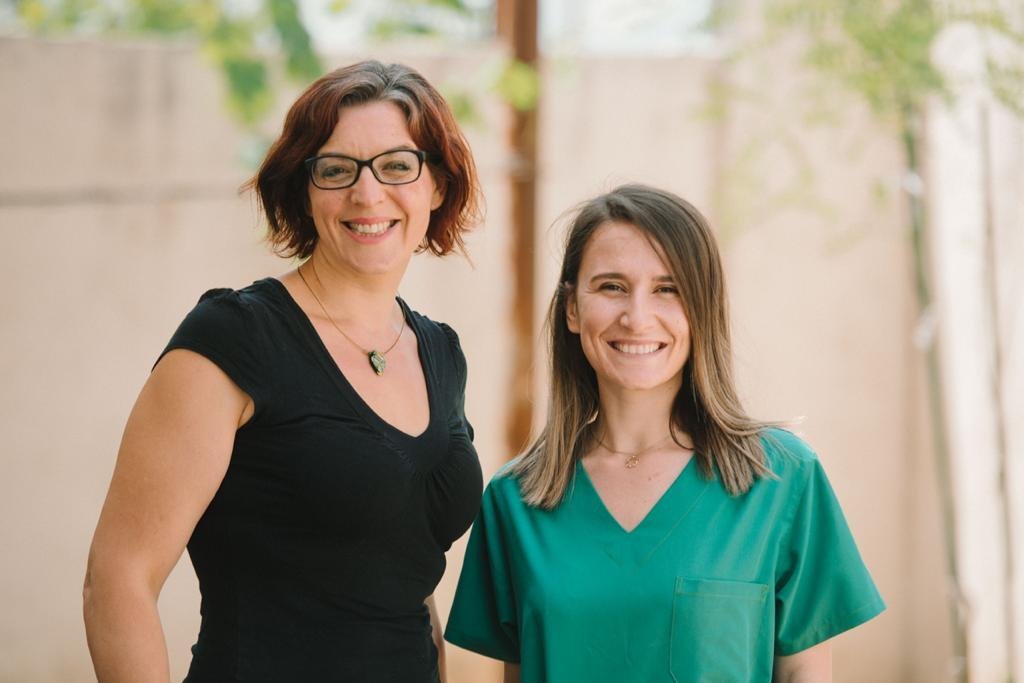
One story stands for hundreds. A woman I'll call Gerta — community members in this article carry pseudonyms to protect them; our team appear under their real names, with their permission — first came to the centre for physiotherapy for a neck problem. She was low, withdrawn; she rarely spoke about herself. Coming in for therapy, she saw the church cell group meeting, and decided to join it. A year later she told us:
“I feel that I can be more myself now, and I love being able to share with others in the group and feel that God is real and with me in a way I never felt before.”
Matilda Dule, our team leader, had visited and prayed with her all through that year. Gerta now drops in between activities just to chat and to ask how she can help. Therapy, sighting, belonging, faith, contribution — and every step depended on a door being open on a day she happened to need it.
A pastor you can find
Our church — Komuniteti i Besimit, the “community of faith,” seventy-eight members across eight cell groups in two cities — is led by Pastor Juri Arapi. He is not a visiting professional; he is a neighbour. He is in the building the community uses all week. The cell groups meet in homes and in the same rooms where the week's other life happens. And there is much less of the divide we take for granted between “home and personal life” and “professional role”: hospitality is how ministry happens, not something squeezed in after hours. When Matilda wrote to thank us after a hard season, her words — unprompted — were that we had been “with us the whole time.” The culture runs inward as well as outward.
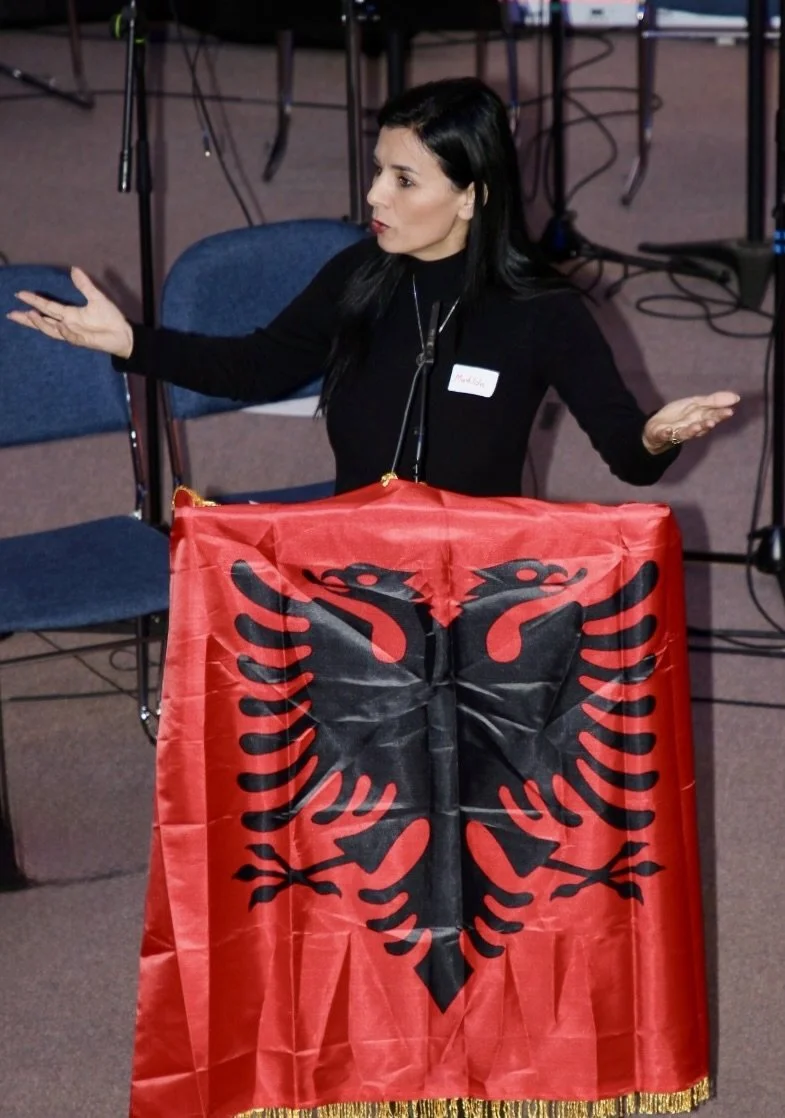
Doesn't that burn people out? Here is what a decade has taught me: what exhausts ministers is not sharing life. It is trying to be two people — one in the role, another at home — and carrying it all alone. At Tek Ura, availability belongs to the whole community: fourteen staff, dozens of volunteers, cell leaders, sixty-five young “Ambassadors” aged eight to fifteen — inside formal supervision and guarded rest. And honesty requires the other half of the ledger: a decade of this has not been cost-free. There have been seasons of exhaustion, workers who needed to step back, years when Annie and I kept our own rules imperfectly. The claim is not that immersion is safe. It is that immersion shared is more sustainable than detachment alone — and its wounds are carried by a community that notices. A shared table carried by forty people is lighter than a caseload carried by one.
Included all the way to the front
British churches often “include” marginalised people as categories: a disability ministry, an addiction outreach, food bank clients. At Tek Ura, the people the world pushes to the edges are the church. Disabled children and their families didn't join it; they helped create it. Roma families excluded from school are walked into classrooms through advocacy and one-to-one support. Adults in recovery are not a client group but cell members. And inclusion means moving toward the centre: participants become Ambassadors, then volunteers, then staff, then leaders; residents' councils in both cities give the neighbourhoods a real say.
For Baptist readers, one reassurance: none of this dissolves the believers' church. The centre of the journey remains what it has always been — faith, baptism, membership. A man I'll call Kristo, a middle-aged carer for his disabled sister, was drawn in by a neighbour's invitation and is now preparing for baptism. That is the pattern working exactly as Baptist ecclesiology intends. Radical inclusion removes every barrier before that threshold — never the threshold itself.
Not even Albania found this easy
Don't imagine Albanians are simply built differently, so that Britain can be excused. The truth is more interesting.
And here's a piece of history worth knowing: the evangelical faith in Albania is not a 1990s import. It goes back to Gjerasim Qiriazi — ordained in 1890 as the first Albanian evangelist — who planted congregations in Monastir and Korça, founded the Evangelical Brotherhood in 1892, and with his sisters opened the nation's first school for girls: gospel, education, and social uplift in one indigenous, holistic, Albanian-led movement. Hoxha's dictatorship erased it almost to the last believer — by 1991, scarcely twenty evangelical Christians remained in the whole country. So the church had to be replanted from nothing, and that replanting was carried sacrificially by Western missionaries in the 1990s. That generation deserves our gratitude: they worked at real cost, translated and taught Scripture, raised a new generation of Albanian leaders. But today's inherited congregations — including the handful of churches in the Albanian Baptist union — date from that decade, and what got planted along with the gospel was a very Western pattern: the big service, the church as destination, the pastor as the central figure everything flows through. So when Tek Ura began, plenty of church people misread us. Some assumed we were a funnel — a clever way of drawing people into the existing churches. The idea that church might grow at the bridge, among the therapy families and the homework club, made no sense at first. Others went further, and warned us against being contaminated by “people like that” — the Roma and Egyptian-heritage families at the heart of our community. That still stings to write.
But slowly, something shifted. Some Albanian believers began to see this radical welcome and stubborn contextualising not as a foreign eccentricity but as something more Albanian than what the missionaries brought — closer to Qiriazi's own Brotherhood, with its gospel-and-girls'-school holism, than the imported architecture ever was — church for the world of the Kafja e Rremës, our own neighbourhood in Tirana, the café-corner world whose people will never cross the threshold of a service designed for the already-convinced. The hardest part for everyone to grasp — Albanian and British alike — was the pastor no longer being the central, set-apart figure. And there is the sting in the tale for us: the detached, central pastor was never an Albanian instinct. It was a Western export. Which means it isn't a fixed law of church life anywhere — including here. It's a habit. And habits can change.
What we're learning in England
Honesty matters most when the story comes home. Our village church plant in Bedfordshire — Vale Community Church — is not among the most needy communities in Britain, and I won't pretend otherwise; the deep-poverty evidence in this story is Albanian, from one of the poorest countries in Europe. What we are testing in England is whether the pattern travels — to an ordinary village with its quieter poverties of loneliness, family strain, and hidden hardship. And we are testing it while carrying two callings at once: a much-loved inherited Sunday congregation with real and legitimate needs, and a planting call to the wider village, balanced week by week inside one shared bi-vocational role. We haven't arrived. The tug between Sunday-as-it-is and the community-not-yet-reached is what this journey feels like from the inside — and if your church tries it, you will feel the same tug. That tug isn't failure. It's what the mixed ecology costs, lived rather than theorised.
And let me honour the people who make it possible, because they deserve better than to appear in this story as a weight being balanced: it is our Sunday congregation — the so-called “inherited church” — who cook for The Table, set it, pray over it, and sit at it among their neighbours. The inherited church is not the obstacle to the new thing. At its best, it is the new thing's kitchen.
But the direction is set. The heart of it is The Table — a weekly free community meal where nobody serves from behind a counter, because everybody eats together. Eighty-three different people came in the first eight weeks, many of whom would never walk through a church door but will gladly sit at a table. Micro-expressions run through the week in the village's own spaces, and we have celebrated baptisms along the way. The harder test — Britain's estates and inner cities — belongs to churches there, and Baptists have form: teams founded by Stuart Murray Williams have practised exactly this kind of embedded, low-threshold planting in our inner cities since 1997. Everything we have learned beside the bridge says it is worth daring.
And to every minister reading this with a sinking heart: this argument is for you, not against you. Many British Baptist ministers already live deeply among their people, at real personal cost, and the set-apart, tested, accredited ministry is biblical and precious. The target of this article was never the office. It is the distance that has culturally attached itself to the office — and every safeguarding discipline, every supervision structure, every safer-recruitment check stays exactly where it is. Safeguarding tells us how to share life safely. It was never meant to tell us not to share life at all.
And dare I say it: detachment doesn't only fail the poor — it starves the pastor. Few of us entered ministry longing for professional distance; we were trained into it, and many are lonely inside it. The same wall that keeps the needy out keeps the minister in. This isn't one more demand on the exhausted. It's the door out of the loneliest room in Baptist life.
Where to start
Not with a programme — with a door and a diary. Open more of your week: one meal, one drop-in, one quiet shared space, with no forms to fill in before someone qualifies for welcome; for a fellowship of eighteen members, one hour of genuine presence done consistently is the mustard-seed version, and it counts. Find the specialists in your congregation — the physio, the teacher, the debt adviser — and invite them to serve as members of the community, edges blurry, not just as providers to it. Rethink the walls between the minister's life and the minister's role, and make availability something the whole church carries so that no one carries it alone. Stay long enough to be known; trust moves at the speed of years. And let the people you welcome become the people who lead — because it isn't really their church until it is.
The Word became flesh and moved into the neighbourhood. He did not commute in, deliver a service, and withdraw. Paul told the Thessalonians he had shared not only the gospel of God but his life as well — as if the two could not travel separately. A little church beside a bridge in Tirana has spent ten years proving they can't.
So here is the question a decade in Albania sends home to every British congregation: what would your community notice if your door was open five days a week?
Please pray for
- The open doors in Tirana and Durrës — and every Gerta who walks through one this week.
- Pastor Juri, Matilda, and the whole Albanian-led team, as they carry a shared life, not a caseload.
- Vale Community Church, balancing a much-loved Sunday congregation with the call of The Table.
- British churches — especially on estates and in inner cities — daring to open more of their week.
Faleminderit shumë — and lavdi Zotit. The best is yet to come.
Dan & the Tek Ura team
Dan Dupree is a Baptist pioneer and missionary. He is Executive Director of Qendra Tek Ura, serves with its UK sister charity At the Bridge, and co-leads Vale Community Church, Marston Moretaine (CBA). Community members are quoted with consent, under pseudonyms; the team appear under their real names, with their permission. A fuller, referenced version of this article is available on request.
