

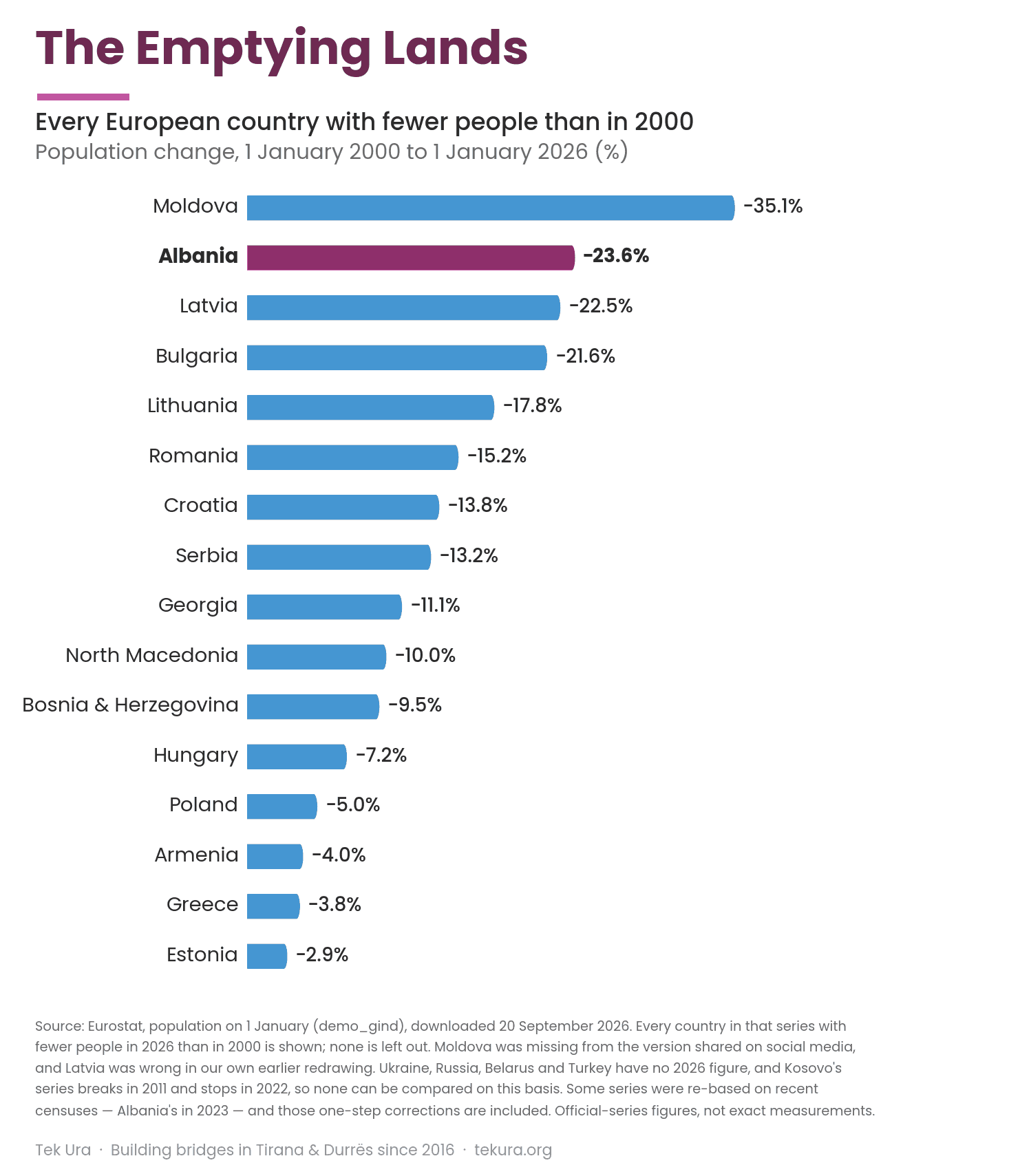
A chart has been doing the rounds on Albanian social media this week. Sixteen countries, sixteen blue bars — and one red one, longest of all, at the top. Albania: minus 23.6 per cent. The figure is right. The ranking, as we found when we checked it, is not.
Since the year 2000, Albania has lost almost one person in four. Around 721,000 people — from a nation that began the century with just over three million. When we checked the figures against Eurostat and Albania's own statistics institute, they held up. If anything, the story behind them is starker than the headline.
Because here is the thing the chart doesn't tell you: Albania is not shrinking because more people die than are born. Last year there were more cradles than coffins — just. The entire loss is departure. In 2025 alone, INSTAT estimates that about 28,500 more people left Albania than arrived. Estimate is the right word: when the 2023 census landed, it showed that the previous decade's departures had been undercounted by more than 370,000. The generation aged 15 to 29 — the ones who would parent, staff and lead the country's future — has shrunk by 45 per cent since 2011. About three-quarters of that is the collapse in births after 1990 working its way up the age pyramid; the rest is departure on top of it. And when researchers ask those who remain, 44 per cent say they would like to live or work abroad — level with North Macedonia, the highest in the Western Balkans. Around 18 per cent mean permanently.
We redrew the chart in Tek Ura colours, and the redrawing cost us our headline. The version being shared leaves out Moldova, which has lost more than a third of its people — a larger share than Albania. Our own first attempt left Moldova out too, and had Latvia's figure wrong. Albania is not the steepest fall in Europe; on Eurostat's table only Moldova has lost more. Truth-telling matters, even when it costs us a superlative. But it changes nothing about the reality on our streets in Tirana and Durrës. We are living in one of the fastest-emptying lands on earth.
Where the chains and the chart meet
In Loose the Chains I wrote about the trafficking chain that links Albanian villages to British streets, and why prevention is not the soft edge of justice but close to its core. This chart is the other half of that story. The emptying and the exploitation are not two issues. They are one.
This month our team finished an evidence briefing — Why People Leave — and How They Rebuild — trawling the academic research on Albanian migration, asylum and trafficking. Some of what we found should unsettle every comfortable assumption, on all sides of the migration debate.
People rarely leave because of one dramatic event. They leave because of an accumulation: an average wage of about £800 a month against European prices, with more than a quarter of employees on a minimum wage nearer £450; hospitals and courts they cannot trust; a future they cannot picture at home. The scholars call it an "aspirations gap" — young Albanians can see the life they long for, and they cannot see a way to it in Albania.
But woven through the economics is something darker. In 2022, more than 17,000 Albanians claimed asylum in the UK, most having crossed the Channel in small boats. Of the 12,700 who came by small boat that year, a quarter were referred into Britain's modern slavery system as potential victims. Half of those referrals still had no decision by May 2025; of the cases concluded, a third were confirmed. Albanians were the second-largest group of potential victims identified in the UK in 2024; in 2025 referrals fell by 22 per cent, and they are now fourth. Behind the tabloid headlines about "economic migrants" are young men lured with "free rides" repaid in cannabis houses, and young women recruited through false romances into something unspeakable.
And for those who come home? The research is heartbreaking in its consistency. Survivors return to stigma, to closed doors, sometimes to family rejection. The clearest risk of being trafficked again is simply this: no job, no safe home, no one who stays.
What the evidence says helps
Here is where the research surprised us — not because it was new, but because it was familiar. Our own review of that research concludes that lasting recovery takes three to five years and stands on four legs: safety, belonging, healing and a real livelihood. Reintegration succeeds where there is patient casework, vocational training a person actually chooses, a paid pathway into work, and — the researchers' phrase — a community that "actively fights stigma."
"Read that list again. It is a description of a table with room for everyone around it." — Daniel Dupree
It is what our Recovery team does through more than a thousand social-work drop-ins a year, through careers groups, through repaired roofs and heater loans and university fees for women in complex situations. It is what our Rehab clinics do for families of children with disabilities — families who name healthcare as their reason for wanting to leave. It is what Komuniteti i Besimit Tek Ura does every week: an Albanian-led church, growing against the demographic tide, where people belong before they believe. We are not a trafficking shelter, and we honour the specialist organisations that carry that frontline. What we offer is what the evidence says makes recovery last: a community that stays.
Rivers in the wilderness
In September, the European Baptist Federation Council gathers in Durrës — our city. Our longing is simple: that when Baptist leaders from across Europe come here, Albania's story would be heard from the people living it — why people have considered leaving, and what changes when belonging, work and dignity arrive. Not our voices — theirs. They are the genuine experts, and our door is open.
"Behold, I am doing a new thing… I will make a way in the wilderness and rivers in the desert."ISAIAH 43:19
The chart describes a wilderness; it cannot see the rivers. We can. We watch them break through weekly — in a teenager who found work instead of a lorry ride, in a mother whose child walked into mainstream school, in a survivor who found a family that will not un-choose her.
One in four has gone. We stay for the three in four who remain — because the best is yet to come, and because we serve a God who plants rivers precisely where the land looks most empty. If your church would like the full evidence briefing behind this article, write to us at info@tekura.org — we will gladly share it.
Please pray for
- The 44 per cent who want to leave — and for the church in Albania that gives people a reason, and the means, to stay.
- Survivors of trafficking returning home to stigma and closed doors: for safety, belonging, healing and a real livelihood.
- The European Baptist Federation Council gathering in Durrës this September — that Albania's story would be truly heard, from the people living it.
- Our Recovery team, led by Roxhers, as they walk the long, slow road of casework, employment and hope.
Faleminderit shumë — and lavdi Zotit.
Daniel Dupree, co-founder & Executive Director, Qendra Tek Ura
